Human Imagination, AI-Assisted Creation
Neural Artistry is my personal creative website, where I explore how human imagination and artificial intelligence can work together to create music, books, visual art, and new forms of storytelling.
At Neural Artistry, human imagination takes the lead and AI serves as a creative partner. The goal is not to replace creativity, but to expand it — using technology to open new possibilities while keeping human feeling, judgment, and imagination at the center of the work.


About
My name is Gary Eichhorn
Musician • Author • Educator • Technology Executive
• Co-Founder of Music & Youth Initiative
I am a musician, writer, educator, and lifelong technology enthusiast. Before founding the Music & Youth Initiative in 2004, I worked in technology-related companies across hardware, software, and medical devices, an experience that shaped my belief that technology is most powerful when it helps people learn, create, and connect.
In 2004, my wife Joan and I founded the Music & Youth Initiative, a nonprofit that helps young people build creativity, confidence, and technical skills through music. Together we created The Music Clubhouse, a youth development model combining music, technology, recording, songwriting, and digital media production in a supportive environment where young people learn by creating.
Neural Artistry continues that same interest in the intersection of creativity and technology. Here, I explore artificial intelligence as a creative partner in songwriting, storytelling, visual art, and other forms of artistic expression.


How I Use AI in Music
AI music refers to music that is generated, assisted, or enhanced by artificial intelligence.
In my work, AI does not replace the musician.
It acts more like a creative partner, helping generate ideas, explore arrangements, separate stems, clean up audio, and test different musical directions.
AI is useful because it works quickly and offers possibilities I might not have considered. But it does not bring lived experience, emotional intent, taste, restraint, or final judgment.
Those choices still come from the person making the music.
Used thoughtfully, AI can expand the creative process without flattening the artist’s voice.
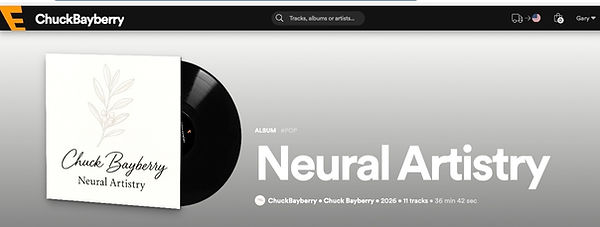
Music by
Chuck Bayberry
(aka Gary Eichhorn)
On Spotify
Original music created through a combination of traditional songwriting,
performance, production tools, and AI-assisted workflows.
l
Buy CD/Vinyl at Elastic Stage
Books
My first book, The Music Clubhouse, co-authored with Joan Eichhorn and David Bickel, was written before ChatGPT and the current generation of AI tools. It was created the traditional way: through lived experience, discussion, drafting, editing, revision, and the judgment of human collaborators.
My later books have been created in a different environment. AI is now part of my writing process, but not as the author. I use AI to brainstorm ideas, test structure, refine language, improve clarity, support research, and prepare production materials. The voice, meaning, tone, and final choices remain my responsibility.
As useful as AI has been, my wife and collaborator, Joan, has been the more important creative partner. She has helped with research, corrected AI hallucinations, edited drafts, challenged weak passages, and contributed in countless other ways.
AI is best understood as augmented intelligence: a powerful tool, but one that still depends on human judgment, lived experience, and purpose.


The Quietest Courage Book and Music Project

The Quietest Courage project brings together family history, storytelling, music, and artificial intelligence in the spirit of Neural Artistry.
The book (available in 2027 on Amazon) is authored by me and researched and edited by Joan. AI served as a practical creative partner: helping generate ideas, test structure, refine language, improve clarity, and support research and source tracking, while I remain responsible for the voice, meaning, tone, and final choices.
The project also includes a seven-track companion musical work by Chuck Bayberry (available on Spotify) I created the melodies and emotional direction for the music, then used AI-assisted tools and Logic Pro to help shape the arrangements, production, and finished sound.
AI Video
For video, Neural Artistry is focused on bringing finished tracks to life as music videos, ranging from fast, release-ready visuals to fully directed narratives.
I primarily use Neural Frames, which lets me start with an “upload the song and generate” workflow when speed matters, then progressively take control: refining an AI-generated storyboard, shaping scenes on a timeline, and (when needed) moving into frame-by-frame editing so the video follows the musical structure and emotional arc with precision.
Click below for my Youtube Channel
